Showing posts with label Bed Bug Elimination. Show all posts

Wednesday, April 8, 2015

Disposal of Furnishings Questions

Photo credit: Vandana (Flickr)

Aloha, today I'd like to focus on another question I am often asked when bed bugs have been discovered in a home (or hotel or place of business, etc). The question is whether or not to throw away and replace the current furnishings and possessions. Most of the time, it is not necessary to dispose of things as successful treatment to eliminate bed bugs can be applied in many cases.

Much of the decision will likely be based on the level of infestation present and the instructions and suggestions by pest control company who is providing treatment. Be sure to follow your pest control operator's instructions carefully, to eradicate the infestation as swiftly and as cost effectively as possible. Another thing to consider is the value of the furniture or clothing. For example, an owner of antique furnishings would likely want to find a solution to clear the bed bug infestation and preserve the valuable and sometimes irreplaceable furnishings. 

About a year ago, when I attended a beg bug convention, there were several companies offering portable tenting devices in which furnishings and other items could be placed inside and then heat treated. While I have no personal experiences with such devices and cannot endorse their effectiveness or any certain manufacture of these devices over another, I think this is a brilliant and promising solution! 

 Obviously the gentleman in this photo would want to step out of the treatment tent before treatment begins!   (Photo from Zappbug.com)

Shelves with varied types of possessions can be treated at one time in these portable tent like "rooms"!    
(Photo from Zappbug.com)

If you do decide to dispose of things, please don’t put your furniture on the curb, or in the dumpster. Definitely don’t sell things on Craigslist or elsewhere, knowing (or even just suspecting) that it has bed bugs.

Pest World (Pestworld.org) has a great bed bug "Best Practices" outline, which among other things, addresses the question about disposal of possessions in much detail. Here are some excerpts from their suggestions (for the full report, click HERE)
  • Disposal of beds, furniture, clothing, and other items should be evaluated on a case-by-case basis since the disposal of these items does not guarantee control of bed bugs, it can place a serious financial burden on people, and replacement items can become infested if brought in prior to control of the infestation.
  • When disposal is necessary, steps should be taken to minimize the likelihood of spreading bed bugs, for example, prior to removal, items need to be wrapped to keep the bed bugs from spreading to other areas during removal.


Monday, December 17, 2012

Bed Bug Eggs - Often Blamed for Failed Eradication

 Magnified photograph of viable (unhatched) bed bug eggs. You can see the little end 'plug' which is where the nymph crawls out of the egg upon hatching.  
(photo by Brittany Delong from Virginia Tech)

This post will focus on the eggs of the bed bug. Often times bed bug eggs are cited and blamed as a reason for failed treatments for bed bug infestations. Not all insecticides used on bed bug infestations are capable of killing the eggs. Additionally, many eggs seem to survive heat and cold treatments, but this is not necessarily due to the eggs being stronger than a live bed bug. Research suggests that instead, bed bug eggs often survive treatments due to their placement in very protected locations. 

The female bed bug deposits her eggs in protected places, even very tight places such as tiny crevices and cracks no wider than the thickness of a razor blade. Some of the most common places eggs are laid are the inside the box springs and the coils of a bed, also behind peeling wallpaper, in closets and along or behind baseboards. In such areas, an exterminator's treatment may not reach the hidden eggs well enough to kill them. 


An adult female typically lays up to 5 eggs per day depositing them in a wide variety of locations, both on and away from a bed. An adult female may lay up to 500 eggs during her lifetime. 

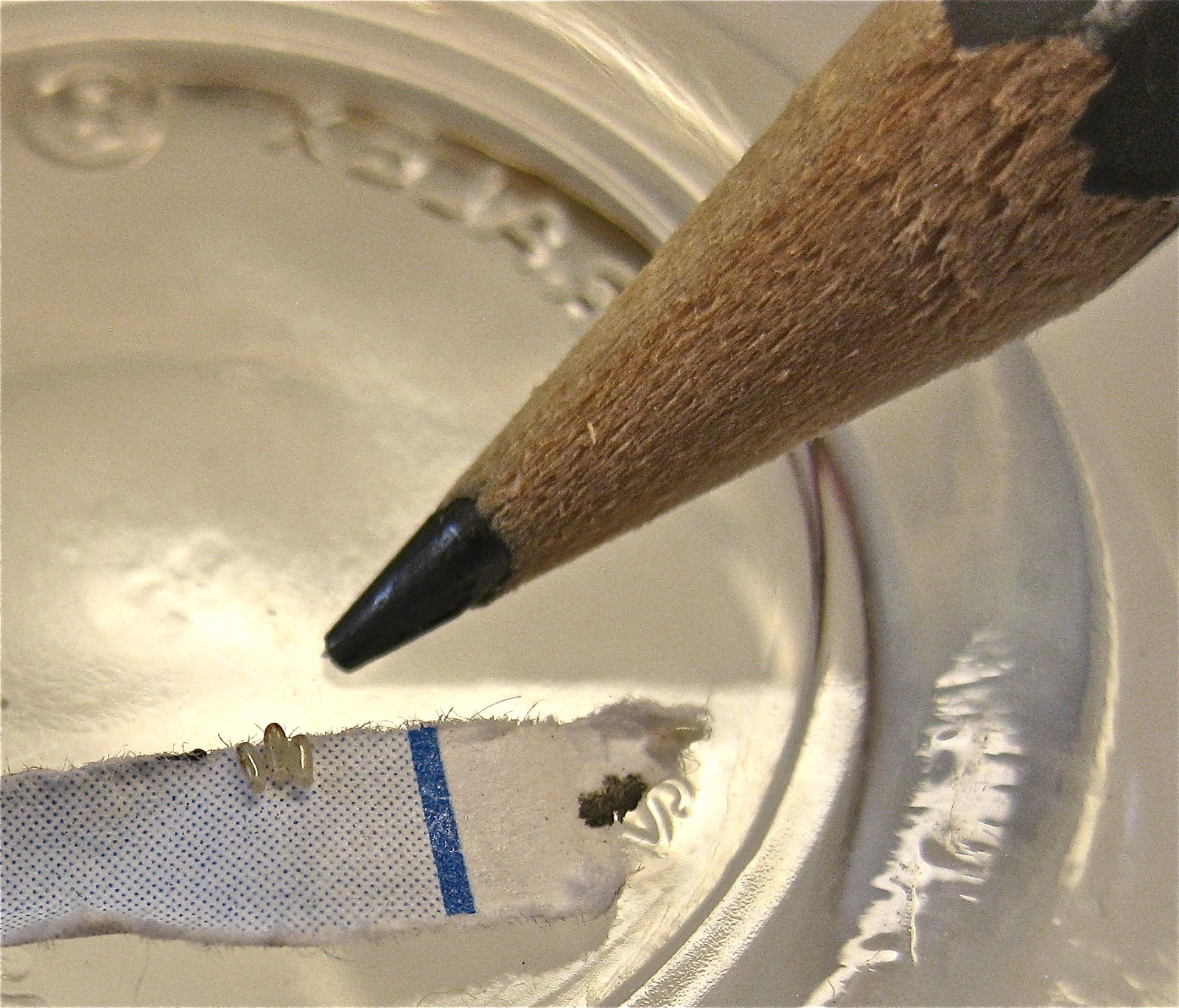
 Adult bed bug on a shred of paper, with 3 unhatched eggs next to it.
(Photo by T. Nakamura, Kilohana K9s)

There is not alot known about the make-up of bed bug eggs. However we do know the following facts; 
  • Eggs hatch approximately 7-10 days after being deposited by the female, but the timing of the hatching depends quite a bit on the air temperature. The eggs do not need a mother around to hatch.
  • When the eggs are laid, a glue-like material covers them allowing them to adhere to the surface they are laid on. They are attached quite well, requiring the use of a stiff brush to dislodge them. After hatching occurs, the eggshells frequently remain stuck in place.
  • The eggs are very tiny and sort of whitish, almost clear in color. They are very hard to see without magnification, especially on light-colored surfaces.  
Bed bug eggshells, after nymphs have hatched. 

Research has shown that with 'cold treatments' it may take 15 days at 32 degrees Fahrenheit (0 degrees Celsius) to kill bed bug adults and 30 days to kill bed bug eggs.  The use of a steamer kills both bed bugs and eggs on contact. Once again, if the eggs are not able to be reached due to their placement, then the steam cannot kill them. All life stages of bed bugs (adult, larva, and eggs) die within minutes at an air temperature of 122 degrees Fahrenheit (50 degrees Celsius). At this high temperature they will 'dry up', so to speak. 

 Close up of 3 eggs laid on a shred of paper. The tip of the pencil is pointing towards them and is shown for size comparison. 
(Photo by T. Nakamura, Kilohana K9s)


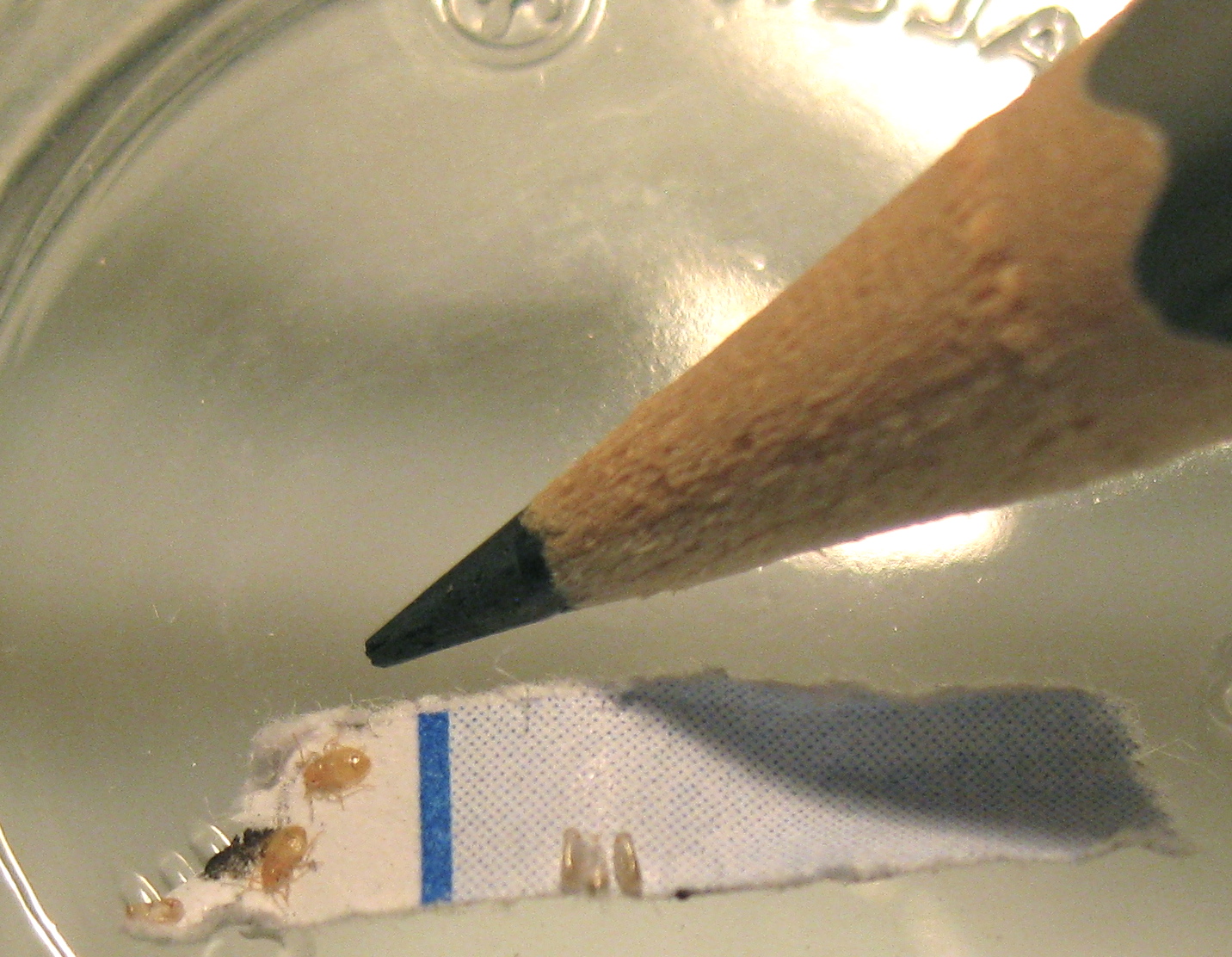
Here are newly hatched nymphs (the pencil tip is pointing to them) next to the egg shells (now empty due to the hatching). As you can see, when they first hatch, the nymphs are nearly transparent and just slightly larger than the eggs (these nymphs are about 4-5 days old). Until they feed for the first time, they will be very difficult to spot with the naked eye.
(photo by T. Nakamura, Kilohana K9s) 

 Development of the newly hatched bed bug (called a nymph) to adulthood takes approximately 1 ½ - 2 months but it can take longer depending upon the environmental conditions and food availability. 

Friday, December 14, 2012

Electronic Bed Bug Repellent Devices Don't Work

One type of Ultrasonic device on the market today.
 
Today the NPMA printed a story from Sciencecodex.com, which provides information on another recent study of a product that is now for sale, which claims to deter bed bugs. ("Bed bugs are not repelled by commercial ultrasonic frequency devices", Posted on Sciencecodex.com: December 10, 2012) 

The story points out ultrasonic frequency pest control devices are available and marketed to the public now and that "despite the lack of evidence for the efficacy of such devices, they continue to be sold and new versions targeting bed bugs are readily available". Here are some excerpts from this story, showing once again, bed bugs are not a do-it-yourself problem.

"According to a soon-to-be-published article in the Journal of Economic Entomology, commercial devices that produce ultrasound frequencies are NOT promising tools for repelling bed bugs. In "Efficacy of Commercially Available Ultrasonic Pest Repellent Devices to Affect Behavior of Bed Bugs (Hemiptera: Cimicidae)," , authors K. M. Yturralde and R. W. Hofstetter report the results of their tests of four commercially available electronic pest repellent devices designed to repel insect and mammalian pests by using sound."
 
"The devices, which were purchased online, were used according to manufacturers' instructions. A sound arena was created for each ultrasonic device, in addition to a control arena which featured no sound. However, the authors found that there were no significant differences in the number of bed bugs observed in the control (no sound) and sound arenas, and that bed bugs were neither deterred nor attracted to the arena with the sound device".

These types of devices often claim to repel many different types of pests. 
They do not help with bed bugs.
 

Wednesday, September 19, 2012

Bed Bug Traps?


Recently I have been asked by quite a few people "what about traps for bed bugs"? In this post I will discuss some points on the use of traps and some of the various types of traps that are available.

Traps for bed bugs are mostly simple in design and there are very few types. However many people are trying to create a trap solution that could be effective against bed bugs and in the future we are likely to see more of these becoming available. It is important to keep in mind that using traps for bed bugs is not a method for eradication. At this point in time, it is merely a tool to be used in the effort to detect the presence of bed bugs.

Some studies have been done on what attracts bed bugs, in an attempt to attract the bed bug to a trap. There are 3 attractants identified so far. They are CO2, heat and chemicals. The research has shown that C02 is the most effective attractant, while heat alone is also effective. Chemical lures show weak results.

The type of traps to be used depends on the circumstances, for example where there is furniture without legs or the furniture legs are not shaped a certain way, traps such as the "Climb-Up" will not work. This type of trap is known as an 'interceptor'. Interceptors do not completely prevent bed bugs from accessing sleeping and resting areas, the inner well is prone to breaking under weight of furniture when carpet is present and they require maintenance (cleaning and re-lubrication) on regular basis. Additionally, interceptors need to be placed for at least a week or longer to detect bed bugs at very low numbers. These may not be suitable for a hotel situation where seeing such traps may alarm guests (especially if a bed bug or any other insect has wandered into one).

 An interceptor type 'trap' for bed bugs (made by Climb-Up).

Dr. Changlu Wang at Rutgers University has developed a bed bug trap that utilizes dry ice to produce C02. This is not available commercially but might give you an idea of some of the work that is being done to create effective traps. PLEASE NOTE; there are some inherent safety risks that are associated with dry ice. DRY ICE REQUIRES SAFE HANDLING. Please do not try to use dry ice yourself at home if you have not been trained to handle it properly.  The carbon dioxide (C02) it creates can suffocate and be deadly for you and your loved ones.

C02 traps are known as "active monitors". At this time, there are 2 commercially manufactured C02 traps available, the NightWatch® Bed Bug Trap (manufactured by Biosensory) the CDC 3000 (manufactured by Cimex Science).

There are also several types of 'monitors' available, some claim to use attractants and other simply provide an attractive hiding place for bed bugs. These can be placed in suspect areas and routinely checked for the presence of bed bugs.

Is is important to state again that while these types of monitoring tools and methods exist, and they have improved recently, there is no tool or method that is completely reliable in detecting bed bugs. Therefore, regardless of what method or device is used, the failure to identify bugs cannot be used as an indicator that no bugs are present. Low level infestations can escape detection regardless of the detection methods implemented, although a well trained scent detection dog has the highest accuracy rates (about 90-98% in clinical research).

If you are serious about early detection, a bed bug dog is more likely to be money well spent and trained bed bug dogs are certainly the best bet when large areas are to be searched. As KILOHANA K9s always stresses, bed bugs are not a do-it-yourself problem, please contact trained professionals to assist you safely!

3 types of active monitors; 1) CDC 3000, 2) NightWatch 
and 3) a trap utilizing C02.

Here is someone's home-made idea. The person utilizing this method is apparently attempting to stop the bed bugs from coming and going from the bed (a somewhat futile exercise in my opinion), however it may help after a period of time has passed, to identify the presence of bed bugs, simply because if one did get into this container it might have a hard time climbing out (bed bugs are not very good climbers on really smooth surfaces).


Wednesday, June 6, 2012

Store Bought Bed Bug Bombs Don't Work

Foggers and Bombs 'bomb out'!

Last summer, while perusing the aisles at my local Home Depot for a catch and release Mouse Trap, I came across the section of do-it-yourself home foggers or 'bombs'. These are often used for cockroaches and other crawling insects and are certainly effective for these. Then I noticed a new type for sale on the store shelves. These bombs claimed to kill bed bugs. I shook my head at this obvious attempt to pry money out of people for nothing in return, certainly the manufacturers of this stuff know these products do not work on bed bugs. Bed bugs can be highly resistant to pesticides (for reasons we will go into in a later posting). This week there is a new study in the news that backs this up. 

Entomologists at Ohio State University tested three commercially available foggers (aka 'bombs'). They are sold as Hot Shot, Spectracide and Eliminator brands. The conclusion, not surprisingly at all, is that all three products were of no use at fighting bed bug infestations. They do not get rid of bed bugs. 

“Based on our findings, bug bombs should not be used for crawling insects such as bed bugs,” says lead researcher Susan C. Jones, Ph.D., an associate professor at the university. “These products shouldn’t even be labeled for bed bugs.” The study appears in the Journal of Economic Entomology, goes on to state that foggers are so ineffective against bed bugs that they probably don’t even warrant taking the small risk of harmful insecticide exposure or other hazards. 


In recent years more than 111 people in seven states got sick from pesticides used to get rid of bedbugs, according to an analysis published last year in the Morbidity and Mortality Weekly Report published by the Centers for Disease Control and Prevention. 


The Ohio State University study began by collecting five different populations of bed bugs from residences in Columbus, Ohio. For a control group, a sixth population was added, known as the Harlan strain, that has been cultivated in a laboratory and carefully sheltered from pesticides since 1973.

The researchers then placed the various bed bug populations in petri dishes and exposed them to the foggers in a campus building slated for demolition. After one test, Jones recalls, “the Harlan bugs were keeled over and all of our field populations [were] just scurrying around as if nothing ever happened to them,” which suggests the non-laboratory bugs were resistant to the insecticide.

In a second series of tests, the researchers added small shelters made of paper discs or cloth to the petri dishes. These shelters, which allowed the bugs to hide during fogging, were designed to mimic the bugs’ natural hideouts, such as the cracks and crevices in floorboards, along mattresses, and behind picture frames.

This time the fragile Harlan strain survived just fine. “The critical issue is that the droplets don’t penetrate cracks or crevices,” Jones says. “They don’t even get to where the bugs are hiding. 
The $10 that you spent on an over-the-counter fogger would be much more effectively spent at a laundromat,” Jones says. The heat of a drier can kill bedbugs and their eggs. 


If you suspect the presence of bed bugs, don't waste your money on these do-it-yourself products. Call KILOHANA K9s or another detection dog service in your area to come inspect your home or business. If the presence of bed bugs is found, have treatment done by a professional pest control company who is experienced with bed bug elimination. Don't put it off too long, bed bugs reproduce quicker and better than cockroaches and it won't take long for them to turn into an expensive nightmare!

Don't let Bed Bugs get cozy in your home while wasting your money 
and time on useless commercially available products!